Uber and Joby Aviation Team Up: Game Changer or Hype?
- Joby is not expected to reach profitability until 2029 to 2031 as it invests heavily in scaling manufacturing and obtaining FAA certification.
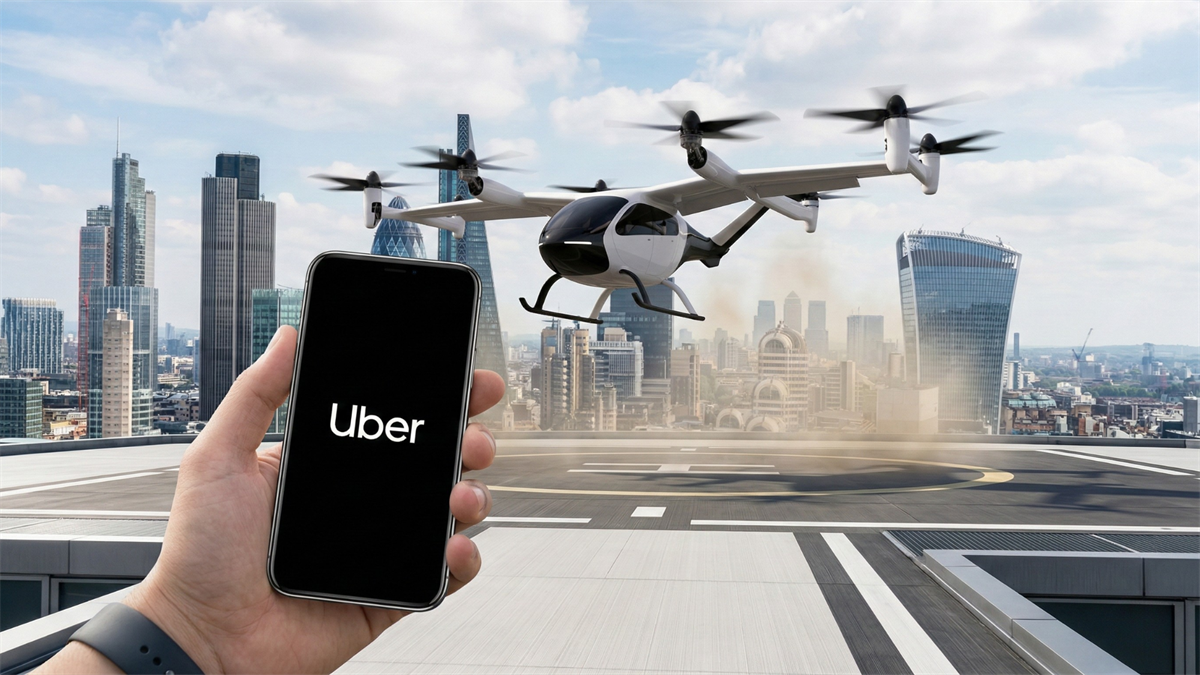
- Last month, the company announced a strategic partnership with Uber that will allow users to reserve eVTOL rideshares through the latter company’s app.
- Despite a surprising revenue beat in Q4, Joby has an annual cash burn rate of approximately $500 million.
An estimated 110 million Americans are stuck in rush hour traffic every day, with drivers in highly congested cities losing as much as 100 hours per year to being stuck in traffic jams.
That issue does not appear to be getting any better, either. Traffic congestion is on the rise in 70 of the 100 largest U.S. cities. But if U.S. Federal Aviation Administration (FAA) approval works out for Joby Aviation (NYSE: JOBY), help could be on its way.
The aerospace company is focused on developing electric vertical takeoff and landing (eVTOL) aircraft for urban air mobility.
Joby’s core mission is to provide zero-emission aerial rideshare services, combining the speed of helicopters with the cost efficiency and environmental benefits of electric propulsion.
If that sounds a lot like the aviation version of what Uber Technologies (NYSE: UBER) offers, that’s because it is.
That alignment has played a central role in the two companies announcing the formation of a strategic partnership last month.
According to a press release, Uber Air will be powered by Joby, “giving riders a first look at how they’ll be able to book Joby Aviation all-electric air taxis directly in the Uber app.”
That announcement came on the same day that Joby reported full-year and Q4 2025 earnings. After gaining nearly 52% over the past year, here is what investors will want to know about the company that is transitioning from its pre-revenue stage.
Q4 Earnings and Revenue Beats Stress the Need for Patience
When Joby reported on Feb. 25, it beat on the top and bottom lines. Earnings per share (EPS) came in at -14 cents, beating analyst expectations of -20 cents, while revenue of $30.84 million easily surpassed analyst expectations of $16.88 million.
But with a trailing EPS of -$1.14, Joby Aviation’s full-year earnings are expected to decrease next year, from -69 cents to -70 cents per share.
The Q4 revenue beat can largely be attributed to Joby’s acquisition of Blade Air Mobility's passenger business, which fueled year-over-year revenue growth of nearly 5,507%.
According to the company, “the acquisition provides Blade’s established network of terminals and loyal flyers in key markets like New York and in Southern Europe, positioning Joby for a faster entry into commercial service with its quiet [eVTOL] aircraft once certified.”
The operative term, however, is “once certified.” Joby has yet to begin commercial eVTOL operation as it continues to navigate the FAA approval procedures.
Joby’s Portability Timeline Is Concerning
The company is currently in the fourth stage of the five-stage FAA Type Certification process for its eVTOL aircraft. Joby is aiming for a launch of commercial services at some point in 2026, once the FAA confirms its aircraft.
But a key milestone for the company will include Part 141 flight academy approval, Part 145 maintenance certification, and testing of FAA-conforming components. As a result, Joby is not expected to reach profitability until 2029 to 2031 as it invests heavily in scaling manufacturing and obtaining FAA certification. That has resulted in an annual cash burn rate of approximately $500 million.
In his earnings call comments, founder and CEO JoeBen Bevrit provided a glimpse of the company’s near-term future, saying it is “seeing unprecedented demand” for its forthcoming eVTOL services from governments, real estate developers, and infrastructure partners around the globe.
Bevrit added that Joby plans “to carry our first passengers this year in the UAE as part of our six-year exclusive access to the Dubai market, and here in the U.S., we expect the government's eIPP program to provide us with the opportunity to demonstrate our service in several locations also this year.”
While the profitability timeline may be concerning to some prospective investors, the company is scaling both production and balance sheet strength at an impressive rate. On Jan. 7, Joby announced that it signed an agreement to acquire a second, 700,000-square-foot manufacturing facility in Dayton, Ohio, for $61.5 million to expand its eVTOL production capabilities. The facility will support it in reaching its 2027 production goals, including manufacturing four eVTOL aircraft per month.
Buyer Beware: Analysts Have Mixed Takes on Joby’s Future
Based on the nine analysts covering JOBY stock, it receives a consensus Reduce rating, with only two analysts assigning it a Buy rating. However, analysts’ average 12-month price target of $13.81 suggests more than 34% potential upside from where shares are currently trading.
Institutional ownership remains tepid at less than 53%, but inflows of $1.31 billion over the past 12 months have easily surpassed outflows of more than $722 million. That said, institutional buying has dramatically slowed down since hitting its all-time high during Q4 2024, falling from $1.03 billion to just $273 million in Q4 2025.
Meanwhile, current short interest—which stands at 12.77%—warrants ongoing monitoring. That figure equates to nearly 79 million shares of the more than 911 million shares outstanding, valued at $779 million, though that dollar amount is down from the record $1.06 billion worth of shares that were shorted in October 2025.