
The Late-Stage Bull Market Is a Buying Opportunity for Tech
- Despite the NASDAQ falling 5% from its October high and tech currently lagging the S&P 500, analysts argue this is late-stage bull market maturity rather than the end of the cycle.
- Several major names—including Adobe, Intuit, and The Trade Desk—are trading at Relative Strength Index levels well below 30. Combined with significant year-to-date losses, these stocks are oversold.
- Improving valuations, including Meta’s forward P/E of 24.13 and Adobe’s 14.78, indicate that earnings potential is becoming cheaper.

After years of leading the pack, the tech sector has been in retreat since the NASDAQ hit its all-time high last October. And while the ongoing sell-off is fueling speculation that the market has entered the late stages of its bull run, for discerning investors, this could present a buying opportunity for names that haven’t been on sale for a while.
Tech stocks finished 2025 with a nearly 34% gain, but after the Feb. 23 loss of 1.68%, the cohort finds itself down around 2.15% year-to-date (YTD), good for the second-worst among the S&P 500’s 11 sectors.
Much of that can be attributed to the underperformance of most of the Magnificent Seven, which have fueled an exodus to defensive sectors and equal-weight exchange-traded funds (ETFs), as well as ongoing fears about an AI bubble and a widespread abandonment of software stocks.
Rumblings of a potential bear market could signal more downside for tech. But even if that materializes, valuations are improving, and analysts are pounding the table about how the growth-focused sector is currently offering value.
A Late-Stage Bull Market Doesn't Mark Its End
As Andrew Slimmon, head of the applied equity advisors team at Morgan Stanley (NYSE: MS), pointed out in the firm’s 2026 market outlook report, a late-stage bull market is not synonymous with the end of a bull cycle.
Slimmon acknowledged that the bull cycle is mature, but said it isn’t over yet, adding that the average bull markets last for five to seven years, “and history favors the bull market in a fourth year,” which is where the market finds itself in 2026.
Those years have historically delivered positive returns, with Slimmon noting that “investors who take higher risk may be rewarded in the coming year, and while corrections are likely in a potentially volatile year for stocks, that could be healthy and support the broader trend upward.”
The NASDAQ is broadly undergoing a pullback, down more than 5% from its October high, but some individual tech stocks are already firmly in correction territory, including some Mag 7 names.
Both Amazon (NASDAQ: AMZN) and Meta Platforms (NASDAQ: META), for instance, are down more than 19% from their respective one-year highs. For Palantir (NASDAQ: PLTR), losses from its one-year high are nearly 37%.
AI-powered, all-in-one customer relationship management provider HubSpot (NYSE: HUBS) has careened more than 43% YTD, and International Business Machines (NYSE: IBM) fell more than 13% on Feb. 23 alone.
That in and of itself doesn’t automatically make any of those stocks a Buy. However, the market’s flight to safety has disproportionately benefited sectors like energy, materials, and industrials while leaving numerous tech stocks oversold.
Evidence of a Buying Opportunity
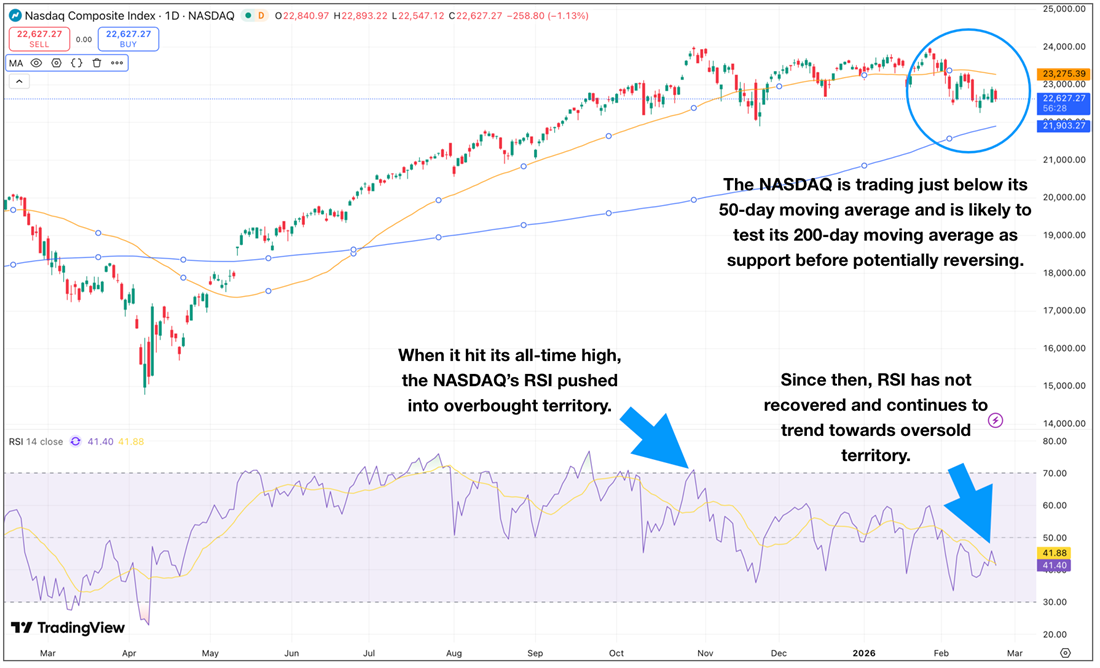
That notion can be supported by both technical and fundamental analysis. The NASDAQ’s current Relative Strength Index (RSI) reading of 41.4 is trending toward 30, or oversold territory. But the tech-heavy index is still trading below its 50-day moving average, as indicated in the chart below, suggesting that more downward price action could occur before the NASDAQ uses its 200-day moving average as support and potentially reverses.
Taking that a step further, MarketBeat’s identified dozens of oversold tech stocks, some of which have RSI readings so far below 30 that they’re hard to ignore, resulting in lofty analyst price targets:
- Adobe (NASDAQ: ADBE): RSI 33, down 26% YTD, 53% potential upside over the next 12 months
- Paychex (NASDAQ: PAYX): RSI 26, down 21% YTD, 40% potential upside over the next 12 months
- Accenture (NYSE: ACN): RSI 24, down 25% YTD, 49% potential upside over the next 12 months
- The Trade Desk (NASDAQ: TTD): RSI 28, down 34% YTD, 131% potential upside over the next 12 months
- Workday (NASDAQ: WDAY): RSI 19, down 39% YTD, 85% potential upside over the next 12 months
- Intuit (NASDAQ: INTU): RSI 18, down 46% YTD, 101% potential upside over the next 12 months
- Automatic Data Processing (NASDAQ: ADP): RSI 20, down 21% YTD, 42% potential upside over the next 12 months
While these numbers can fluctuate and change quickly, the sector-wide theme is clear. For investors who still believe in the long-term bull thesis of the technology sector, the red market represents a compelling opportunity.
Fundamentally, many of these stocks are improving, too. Returning to the Meta Platforms example, the Mark Zuckerberg-led company’s trailing 12-month (TTM) price-to-earnings (P/E) ratio of 27.37 was somewhat elevated. But its forward P/E ratio 24.13 suggests more earnings per dollar invested going forward.
That’s underscored by Meta’s year-over-year (YOY) earnings per share (EPS) growth over the past three years. In 2023 following the last bear market, that figure stood at more than 73% YOY. In 2024, it was nearly 61% YOY. Last year, it plummeted to -1.55%, suggesting a statistical regression toward the short-term mean could be in the cards this year.
That’s happening outside of the Magnificent Seven as well. Adobe’s forward P/E is 14.78, Paychex’s is 17.72, and Accenture’s is 15.77. Meanwhile, those three companies’ five-year annual average EPS growth rates are 10.01%, 9.01%, and 9.20%, respectively.
Stocks Mentioned in this Article
| Company | Current Price | Price Change | Dividend Yield | P/E Ratio | Consensus Rating | Consensus Price Target |
|---|---|---|---|---|---|---|
| Meta Platforms (META) | $653.69 | +2.3% | 0.32% | 27.82 | Moderate Buy | $844.44 |
| Palantir Technologies (PLTR) | $134.19 | +4.2% | N/A | 213.00 | Hold | $191.05 |
| Amazon.com (AMZN) | $210.64 | +1.0% | 0.09% | 29.38 | Moderate Buy | $287.29 |
| Morgan Stanley (MS) | $173.76 | +2.9% | 2.30% | 17.02 | Moderate Buy | $185.93 |
| HubSpot (HUBS) | $245.36 | +5.5% | N/A | 282.02 | Moderate Buy | $452.70 |
| International Business Machines (IBM) | $237.75 | +3.7% | 2.83% | 21.32 | Moderate Buy | $320.87 |
| Adobe (ADBE) | $257.81 | +1.0% | N/A | 15.43 | Hold | $392.76 |
| Paychex (PAYX) | $91.23 | +3.1% | 4.74% | 20.69 | Reduce | $123.94 |
| Trade Desk (TTD) | $25.16 | +0.9% | N/A | 28.92 | Hold | $57.58 |
| Workday (WDAY) | $133.15 | +2.2% | N/A | 55.95 | Moderate Buy | $208.28 |
| Intuit (INTU) | $381.23 | +6.3% | 1.26% | 26.06 | Moderate Buy | $726.18 |
| Automatic Data Processing (ADP) | $214.25 | +4.2% | 3.17% | 20.60 | Hold | $290.00 |