
Tesla’s Robotaxi Launch Wasn’t the Moment Investors Expected
- Tesla's muted Cybercab launch in Austin lacked pricing, fleet, and revenue details, disappointing investors and sending shares down nearly 8% from their intraday high.
- Federal safety regulators opened an investigation into the Cybercab's lack of a steering wheel and pedals, raising regulatory risks that could delay wider rollout.
- Tesla's narrow, cautious rollout leaves it far behind rival Waymo, which already provides hundreds of thousands of weekly rides across numerous markets.
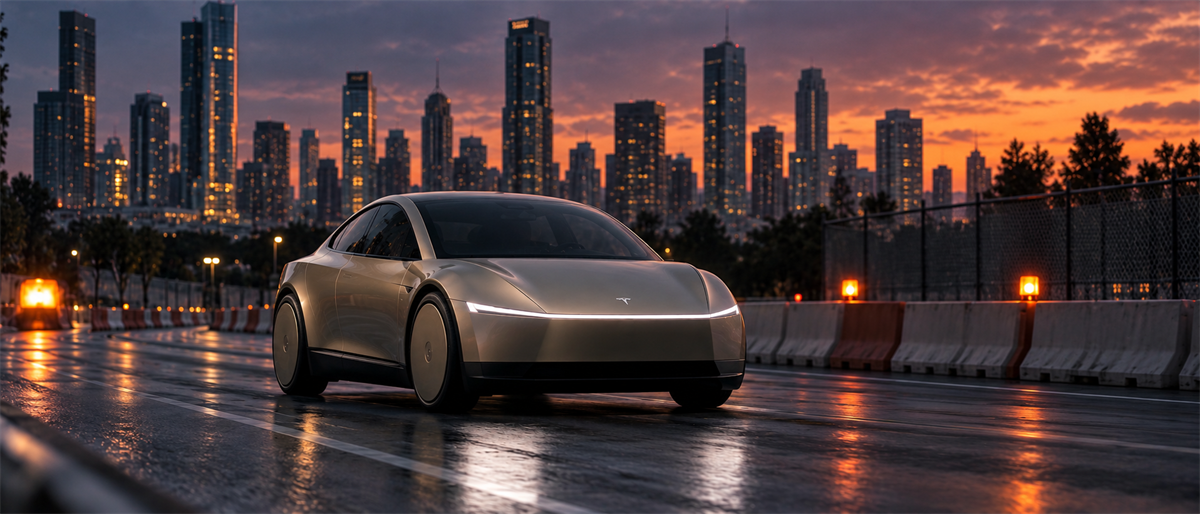
Anticipation had been building for weeks leading up to last Thursday, and rightly so. Tesla Inc. (NASDAQ: TSLA) was finally set to launch its Cybercab, the purpose-built robotaxi meant to propel it to the front of the self-driving race, and investors had been sending the shares higher, expecting a landmark moment.
Instead, Thursday’s event landed with a thud. There was no livestream, no appearance from Elon Musk, and crucially, no detail on how Tesla intends to price, scale, or make money from the service. The market's reaction was swift, with the stock sliding nearly 8% from its intraday high into the long holiday weekend, snuffing out what had been shaping up as a promising rally.
Tesla shares have steadied a little since, but the damage was done, and the stock remains stuck in its months-long downtrend.
Still, with the shares still up around 20% from July's low, it's worth asking whether this stumble marks a serious setback for Tesla's robotaxi ambitions, or whether the dip is actually a buying opportunity.
A Launch That Raised More Questions Than It Answered
Investors' core frustration seems to have been a lack of substance. Rather than the bold statement of intent they’d hoped for, the launch amounted to a limited rollout in a small, tightly defined zone of Austin, with barely any of the information the market needed to get excited about its progress.
There were no figures on fares, no targets for fleet growth, and no sense of the all-important economics: cost per mile, utilization rates, or the revenue each vehicle might generate. Without those numbers, it’s hard to tell if the service is really scaling toward a commercial business or merely inching from demonstration into cautious testing.
For a company whose valuation rests so heavily on the promise of autonomy, that absence of hard detail like this was always going to disappoint. The market wanted to see a business take flight; instead, it saw a carefully controlled experiment.
The Regulatory Cloud
If the muted launch was the first blow, the second came less than a day later. On Friday, it emerged that federal safety regulators had opened an investigation into the Cybercab, and their focus fell on the vehicle's most radical feature, the one thing that makes its autonomy possible: its complete lack of a steering wheel and pedals.
That headline matters because the Cybercab was never intended to be a modified conventional car like some of its competitors. The fact that its stripped-back design is raising fresh safety concerns strikes at the very thing that was supposed to set it apart. Adding to the uncertainty, it appears some states may push back on Tesla's decision to rely on cameras alone for navigation, rather than using the additional radar and laser sensors favored by some rivals.
None of this is necessarily fatal in the long run, and other robotaxi operators have navigated similar reviews before winning approval. But it introduces a real risk of delay and reminds us that Tesla's path to a nationwide network of self-driving taxis will be bumpy.
Disciplined, or Falling Behind?
The limited scale of last week's launch also caught many investors off guard, and it raises a simple question: Are Tesla's robotaxi ambitions definitely on track, or are they being left behind? Both camps make a fair case.
To the optimists, Tesla's narrow rollout is exactly the right call. By starting small in its home city, Tesla can gather data, refine its systems, and avoid the kind of high-profile early failure that could set the whole project back. Management has made this clear, stressing its desire to get things right before expanding into bigger markets, a sensible priority.
The opposing view is less charitable, however. It holds that the limited launch underlines how far behind Tesla remains. Its best-known rival, Alphabet’s Waymo, has already logged hundreds of millions of autonomous miles and is providing hundreds of thousands of paid rides every week across numerous markets, a scale that dwarfs Tesla's tiny Austin footprint.
Making Sense of It All
In truth, last Thursday's launch was neither the triumph the bulls wanted, nor the disaster the bears feared. It was an early milestone, proof that Tesla is edging from concept toward a real, deployable product, but not firm evidence it can build a business to rival the established leaders.
That being said, Tesla's longer-term vision for its Cybercab is still compelling. By building the vehicle, the software, and the charging network itself, it could one day run a robotaxi service far more cheaply than rivals reliant on expensive third-party hardware.
But that’s a bet on the future, and last week did little to bring it closer. The stock's negative reaction reflects that disappointment, and it’s perhaps no surprise that Tesla carries a MarketBeat consensus rating of Hold. For now, Tesla appears to have taken a promising first step, but it still has a lot of work to do to fully convince the market it can deliver on its Robotaxi ambitions.
Stocks Mentioned in this Article
| Company | Current Price | Price Change | Dividend Yield | P/E Ratio | Consensus Rating | Consensus Price Target |
|---|---|---|---|---|---|---|
| Tesla (TSLA) | $367.81 | -0.1% | N/A | 340.57 | Hold | $401.74 |