
Tesla's Roadster Reveal Hints at 2 Much Bigger Moves
- Tesla unveiled a flying Roadster using SpaceX thrusters on Oct. 15, but analysts view the vehicle itself as a halo product unlikely to affect earnings soon.
- The Roadster drove itself during the demonstration, reinforcing the bullish thesis that Tesla is becoming a "physical AI" platform built around autonomy and robotics.
- Speculation about a Tesla-SpaceX merger has intensified, with analysts like Dan Ives citing an 80% chance by 2027, though Tesla still trades at a price-to-earnings ratio above 300.
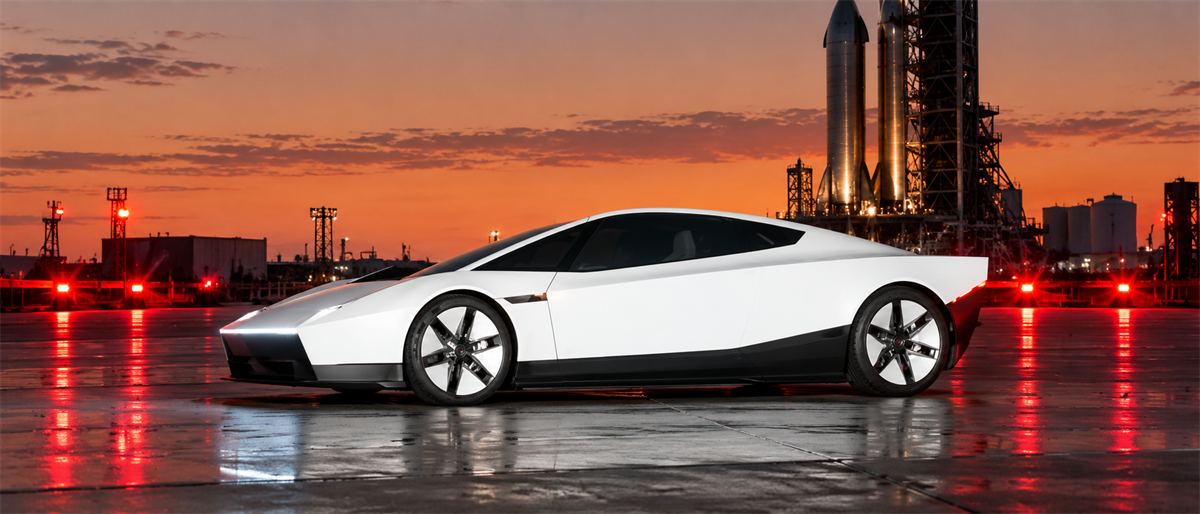
Tesla Inc. (NASDAQ: TSLA) certainly knows how to put on a show. On Oct. 15 at a SpaceX testing facility in Texas, the company unveiled a redesigned Roadster that did something no car has managed before: it flew, pulling mid-air flips alongside a 0-to-60 sprint of around 0.8 seconds using compressed-air thrusters developed with Elon Musk's rocket company, SpaceX Corp (NASDAQ: SPCX).
The stock jumped on the reveal before cooling off, and it now trades around $360, roughly the same level it was two months ago. For all the spectacle at last week’s event, investors seem to have quickly realized that it will take years to register on Tesla’s bottom line. From that regard, it’s actually quite tempting to file the whole thing under “stunt” and move on.
However, that would be a mistake. Beneath the theatrics sat two signals that matter far more than a flying sports car, and they landed at just the right time, with Tesla due to report earnings on Oct. 21.
A Stunt, and Tesla Knows It
Start with the obvious: the Roadster is a halo car, not a serious revenue line. Tesla first showed off a next-generation version almost nine years ago and once promised deliveries in 2020, yet production has now slipped all the way to a targeted start in 2028, and Tesla has yet to disclose expected volumes. Even if a few thousand Roadsters eventually reach customers, they won’t move the dial at a company Tesla’s size.
Wall Street has reasons to be cautious. JPMorgan’s Rajat Gupta, who rates the stock Neutral, noted that Tesla had not disclosed final pricing or anticipated production volumes. On that narrow point, the skeptics are right: as a product, the Roadster is a distraction dressed up as a milestone.
Signal #1: Autonomy Remains the Endgame
Look past the showmanship, though, and the event flashed two signals the bulls should take seriously. The first is the quiet one: during the demonstration, the Roadster performed its stunts without a driver, although it was remotely controlled rather than using Tesla's Full Self-Driving system. More tellingly, Musk said the Roadster would eventually be the only manually driven vehicle Tesla makes, even as the rest of its lineup moves toward autonomy.
That matters because it feeds the thesis that has come to define the stock: Tesla is less a carmaker than a “physical AI” platform, with the vehicles as the body that carries the brains. Star analyst Dan Ives from Yorkville Ives, a longtime bull, reckons that autonomy, robotaxis, and the Optimus robot now make up roughly two-thirds of his $500 price target, leaving the car business as the base beneath. A flying sports car that pilots itself is, in that light, less a toy than a rolling billboard for the software Tesla is really selling.
Signal #2: A Merger Moving From Meme to Maybe
The second signal is louder: the long-rumored combination between Tesla and SpaceX is suddenly being taken far more seriously. Showcasing SpaceX's rocket propulsion and control hardware on a Tesla product gave investors a tangible glimpse of what a combined company might actually look like, and the speculation has caught fire since.
Ives now puts the odds of a Tesla-SpaceX merger by the end of 2027 at 80%, while Barclays has floated the idea that an announcement could land before Tesla’s shareholder meeting, which has been set for Dec. 3, most likely built around merging the two firms’ AI and robotics work across robotaxis and Optimus. Prediction-market traders have moved too, now pricing better-than-even odds of a deal by spring 2027.
None of this is confirmed, and a combination of that size would be fiendishly complex to pull off. But the talk is no longer idle; hard engineering is on display, and analysts are willing to attach real numbers to it.
The Catch Is the Price
For all that promise, the bears have a sharp rebuttal, and it explains why the stock carries only a MarketBeat consensus rating of Hold. Strip away the showmanship, they argue, and Tesla keeps leaning on flashy demos. At the same time, its most valuable projects, robotaxis and humanoid robots, still aren't running at scale, despite pointing to markets that could one day be worth more than a trillion dollars. Rivals are closing in, regulatory hurdles remain, and shares still trade at a trailing price-to-earnings ratio of more than 300.
That’s a rough, but valid, take on things, and it means this week’s earnings report matters far more than any self-driving midair barrel roll. Investors will be hunting for signs that the robotaxi rollout and Optimus are turning from slideware into revenue, not just more dazzling engineering.
So while the Roadster demo may have been a stunt, the two signals behind it, Tesla's continued push toward autonomy and a merger that’s looking more likely than ever, are what the bulls are really paying up for. Whether that vision justifies a price north of 300 times earnings is the question this week's report will have to try and answer.
Stocks Mentioned in this Article
| Company | Current Price | Price Change | Dividend Yield | P/E Ratio | Consensus Rating | Consensus Price Target |
|---|---|---|---|---|---|---|
| Tesla (TSLA) | $373.71 | +1.5% | N/A | 346.03 | Hold | $415.07 |