
Microsoft’s Next AI Leg: Can MSFT Still Outperform From Here?
- Microsoft stock is trading near a 52-week low with a P/E ratio around 23, making it one of the cheapest Magnificent 7 stocks by valuation.
- Investor concerns include rising AI infrastructure spending, uncertainty around the OpenAI partnership, and slow early adoption of Copilot Pro.
- Despite near-term headwinds, Microsoft’s strong free cash flow, bullish analyst sentiment, and oversold technical signals suggest upside.
It may be time for investors to start shopping for discounted stocks. It might surprise some to find that Microsoft Corporation (NASDAQ: MSFT) is on the metaphorical clearance rack in relation to its cohort of Magnificent 7 stocks. In fact, MSFT stock is within about 10% of its 52-week low caused by the tariff turmoil in early 2025.
And it’s not just price; there’s a valuation issue to consider. As of this writing, MSFT stock trades at a price-to-earnings (P/E) ratio of approximately 23X earnings. That puts it at a discounted level not seen since 2022.
This leaves investors with an intriguing dilemma. Is Microsoft a blue-chip stock whose best days are behind it? Or is this a stock that’s offering investors a generational buying opportunity?
The Sell-Off Hasn’t Been Entirely Unjustified
It’s been a difficult five months to own technology stocks. Many narratives have been layered on one another, making investors skeptical. The latest rumor centers around artificial intelligence (AI) wiping out the profit margins of software companies and software-related stocks.
There’s also broad concern about capital expenditures (CapEx) to support the growth of AI infrastructure. Analysts expect Microsoft to spend between $100 billion and $120 billion to support its ongoing AI buildout in 2026. That’s up sharply from prior years.
Microsoft also presents some company-specific concerns. For example, the company’s partnership with OpenAI looks shakier than it did 18 months ago. To put a dollar figure on that partnership, OpenAI signed a multi-year deal with Microsoft in October 2025 valued at $250 billion. That’s about 40% of Microsoft’s $625 billion backlog.
The problem for analysts is that OpenAI doesn’t have Microsoft’s balance sheet. That’s leading to appropriate concerns over how much of that $250 billion will be recognized.
Microsoft’s AI Monetization Faces Early Challenges
Investors also have concerns about Microsoft’s in-house AI development, specifically Copilot Pro. This is the paid, premium version of Microsoft’s Copilot AI assistant. It’s sold as an add-on to Personal and Family subscriptions at about $20 dollars per user per month.
Copilot Pro unlocks deeper integration of Copilot in core Office apps like Word, Excel, and Outlook, offers priority access to more advanced models (such as GPT‑4‑class models) even during peak times, raises or removes many of the usage limits in the free tier, and expands image creation, “deep research,” and other advanced features for power users who rely heavily on Microsoft 365.
However, the launch of Copilot Pro has gotten off to a lackluster start. In its Q2 2026 conference call, the company said it now has 15 million paid Copilot subscribers. However, that’s only about 3% of its 450 million commercial customers.
Why This Time Isn’t Different
None of those concerns matters if the company can continue to produce strong growth. However, that’s another area where analysts are becoming concerned. It’s not that Microsoft isn’t growing. The concern is whether it can grow as strongly as needed to justify the company’s CapEx spending and potential AI headwinds, particularly with their Azure cloud computing division.
But the better question is, can Microsoft afford its growth? The answer to that is a resounding yes. The company generated over $97 billion in free cash flow over the trailing 12 months. That's not a company that’s in danger of having to raise capital to fund its growth ambitions.
With all that said, Microsoft presents investors with a growth story that may not be fully appreciated, and very much not priced into its stock. Beyond its compelling P/E ratio, the company now has a price-to-earnings growth ratio of around 1.4, which is approaching a level known as a strong buy.
Speaking of being a strong buy, analyst sentiment continues to be bullish. The Microsoft analyst forecasts on MarketBeat show that 45 analysts have a consensus Moderate Buy rating on the stock with a price target of $591.87, an upside of over 55%.
Key Support and Oversold Signals
The MSFT stock weekly chart shows a multi‑year uptrend still intact, with price recently pulling back to test long‑term trendline support near the rising 200‑week moving average around the high‑370s. The current consolidation follows a sharp decline from all‑time highs, suggesting investors are reassessing rich AI‑driven expectations rather than abandoning the broader bullish trend.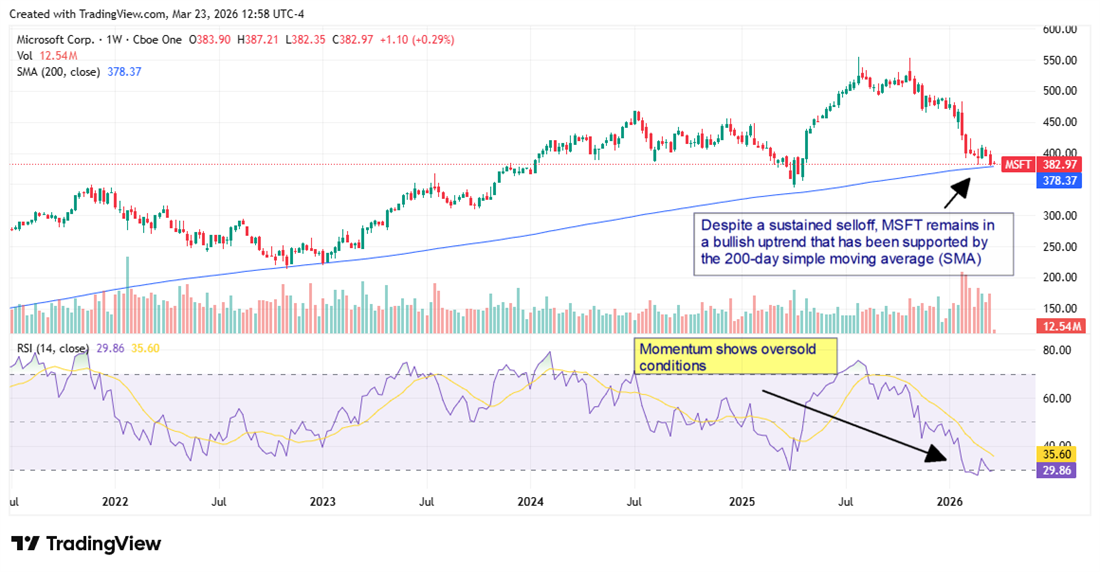
Volume has picked up on recent down weeks, signaling distribution, but not yet the type of capitulation that typically ends a major cycle. The 14‑week RSI has slipped into oversold territory near 30, a zone that has historically preceded tradable rebounds in prior MSFT pullbacks. As long as the stock holds above the 200‑week moving average and the long‑term trendline, the primary uptrend remains technically viable, with risk skewed toward a medium‑term basing phase rather than a full trend reversal.
Stocks Mentioned in this Article
| Company | Current Price | Price Change | Dividend Yield | P/E Ratio | Consensus Rating | Consensus Price Target |
|---|---|---|---|---|---|---|
| Microsoft (MSFT) | $370.25 | -0.7% | 0.98% | 23.16 | Moderate Buy | $588.97 |