
Buy CrowdStrike Before the Stock Split? Here's the Case
- CrowdStrike posted 26% revenue growth and 51% EPS growth while raising its ARR outlook for the fiscal year.
- The company's expanded $1.5 billion buyback authorization signals confidence in future cash flow generation.
- While the stock split doesn't change valuation, a lower share price could attract additional retail investor demand.

CrowdStrike Holdings Inc. (NASDAQ: CRWD) is up approximately 45% in 2026, making it one of the best-performing stocks of 2026. However, CRWD is down approximately 10% since reporting solid earnings on June 3.
That dip comes even though the company’s board approved a 4-for-1 stock split. Shareholders of record as of June 25 will receive three additional shares for every share they own, and the stock is expected to begin trading on a split-adjusted basis on July 2.
A stock split can increase shareholder value indirectly, but by itself, shouldn’t be a reason to buy or sell a stock. Instead, investors ought to look at the company’s fundamentals and its valuation.
CrowdStrike Just Delivered a Strong Report
It's hard to overstate the strength of CrowdStrike’s recent earnings report. The cybersecurity company beat on the top and bottom lines. Revenue of $1.39 billion was up 26% year-over-year (YOY). Earnings per share (EPS) growth was even stronger with the company’s $1.10 coming in 51% higher YOY.
A key metric for cybersecurity companies is annual recurring revenue (ARR). CrowdStrike’s Falcon platform has had a significant flywheel effect in which companies sign up for one or more services and not only continue to use those services but also add additional modules over time. That’s a key reason why the company raised its net new ARR growth guidance for the current fiscal year by 520 basis points to 27.7%.
Look Past the Split: What Actually Supports CRWD
Simply put, there's a difference between price and value. A stock split doesn't change a company's valuation, so the fact that CrowdStrike will soon trade at a more accessible price won't make the stock a better value than it was pre-split.
And on traditional valuation metrics—price-to-earnings (P/E), price-to-sales (P/S), and price-to-book (P/B)—CRWD looks expensive, so investors focused on those measures may find better options elsewhere. The bull case for the stock rests less on it being cheap and more on other factors.
One of those is that the company is betting on itself. CrowdStrike recently announced a $500 million increase to its prior authorization, bringing the new authorization to approximately $1.5 billion. Companies don’t increase a buyback authorization without the free cash flow (FCF) to support it.
Another is index membership. CRWD is part of the S&P 500 index, and it was the fastest cybersecurity company to achieve that milestone. It also means the stock is included in many of the largest technology and cybersecurity-focused exchange-traded funds (ETFs) and index funds. Over 71% of the stock’s shares are owned by institutions.
The takeaway for investors: a lofty share price doesn't appear to be keeping people away from the stock.
Why You Shouldn’t Discount the Split
The split won't change CRWD's valuation, but it could still change how investors respond to the stock—and with more retail investors in the market than ever, that psychology matters.
Many retail investors prefer not to own fractional shares, even though the option is available to them. For those investors, seeing CRWD trade for under $200 is likely to hold significantly more appeal. That’s particularly true for growth-focused investors. CrowdStrike doesn’t pay a dividend, so aside from buybacks, stock price appreciation is the primary compensation for shareholders.
To be clear, none of this is the "right" reason to buy CRWD—a split creates no real value. But markets aren't perfectly efficient, and sometimes how investors feel about a price matters as much as the underlying valuation.
A Cautiously Bullish Chart
CRWD is trading around $690, well extended above its 50-day simple moving average (SMA) at $571.48. That gap signals strong momentum, but also elevated short-term risk.
The stock staged a powerful breakout in May, surging from the $400s to a high near $790 before pulling back into a consolidation range around $680–$720. That pullback appears healthy rather than bearish, with price holding well above the 50-day SMA.
The relative strength index sits at 59, with the signal line at 61. The bearish RSI cross visible on the chart coincides with the recent peak. That's a classic momentum fade following an overbought reading above 80. Current RSI levels are neutral-to-bullish, leaving room to run without immediate overbought pressure.
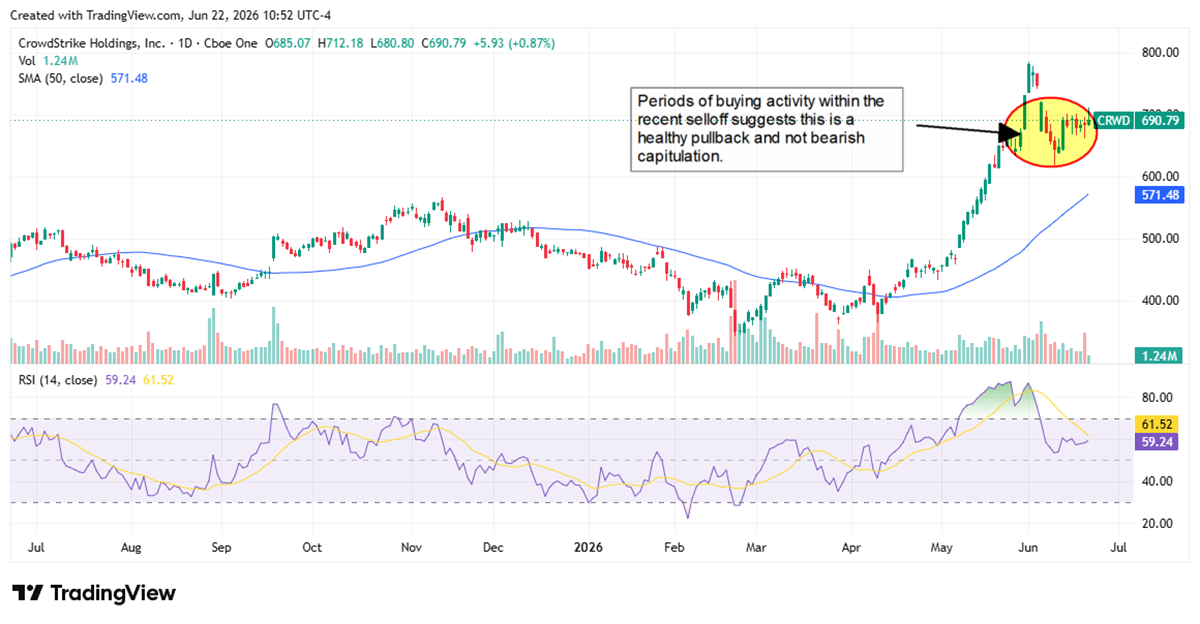
Adding to that optimism, volume remains constructive, supporting the thesis that institutional buyers absorbed the breakout. The dotted resistance line near $760–$780 is the key level to watch on the next leg higher.
Stocks Mentioned in this Article
| Company | Current Price | Price Change | Dividend Yield | P/E Ratio | Consensus Rating | Consensus Price Target |
|---|---|---|---|---|---|---|
| CrowdStrike (CRWD) | $685.14 | +1.4% | N/A | -3,605.80 | Moderate Buy | $692.71 |