
ASML Can’t Keep Up With AI Demand—Why That's a Good Thing
- ASML's CEO said demand will exceed supply through 2028, even after planned 30% capacity increases over the next two years.
- The company posted mixed Q3 revenue but stronger margins, raised full-year guidance and issued a strong forecast for the fourth quarter.
- Analysts maintain a consensus Moderate Buy rating with roughly 25% upside, while technical charts and capital returns point to further gains.
ASML (NASDAQ: ASML) sent two strong signals in its Q3 report: one company-specific and the other is AI industry-wide.
The company-specific signal is that demand is high—so high, in fact, that planned 30% capacity increases over the next two years won’t cover it. According to CEO Christophe Fouquet, demand will exceed supply through 2028, pushing the company to make critical decisions. These include ramping capacity and increasing plans for new capacity, as industry signals are also robust.
The industry-specific signal is that demand remains strong across compute and memory, with supply constraints likely to linger into 2028, if not beyond. More importantly, clients are interested in 2029 and 2030 products, underscoring the timing and intensity of AI demand, which the broader market still underestimates. These signals translate into solid results for ASML and improved guidance, with trends suggesting not only strength but outperformance and the potential for acceleration in upcoming quarters.
ASML’s Mixed Quarter Overshadowed by Demand Signals and Guidance
ASML reported a mixed quarter, with Q3 revenue falling slightly short of the consensus, but the bar was high. Nearly 100% of earnings forecasts were increased since the last report, pricing in an immediate production ramp, despite how unlikely that was to be realized.
Third-quarter sales were underpinned by new and used machines, as well as services to the installed base. Installed base revenue grew 19%, new unit sales increased 31.3%, and used unit sales increased marginally.
Margin news was also good, better even than revenue. Gross margin widened from increased leverage and sales strength, driving strength through the report to the bottom line. While investments impaired cash flow, the impact is minimal, leaving the company’s position strengthened. Adjusted earnings per share outperformed by 2,000 bps, aided by a one-off, but still better than expected when excluding the one-off gain.
Guidance sets the stage for future catalysts. The company raised the low end of its full-year guidance, issued a strong forecast for Q4, and will likely perform at the high end of the range, if not outperform. Catalysts include next year's guidance, which will reflect ASML's planned 30% increase in chipmaking equipment production capacity in 2027, as well as any additional capacity expansions the company announces.
ASML’s Dividends, Buybacks and Bullish Signals Point to More Upside
Among ASML’s attractions are its capital returns. The company pays dividends, buys back shares and can accelerate both in the coming year. The interim dividend payment is tracking the trend, with 10 years of steady increases at a double-digit pace and a low 20% payout ratio. Share buybacks offset share-based compensation and incrementally reduce the share count, boosting per-share earnings growth and investor leverage.
Analysts expressed some caution over the capacity constraint, noting it can hinder growth, but are otherwise bullish on the stock. The 27 tracked by MarketBeat reflect a strong conviction in the consensus Moderate Buy rating and price target, which forecasts approximately 25% upside as of mid-October. The trend is important, with price targets rising ahead of the release. High-end price targets suggest a move to the $2,600 range within 12 months, representing approximately 50% upside.
Technical signals are equally bullish. The market is consolidating as of mid-Q4 but remains within the uptrend and indicates higher levels. Support appears strong near $1,600, the MACD shows a head-and-shoulders reversal pattern, and the market is set up to swing higher.
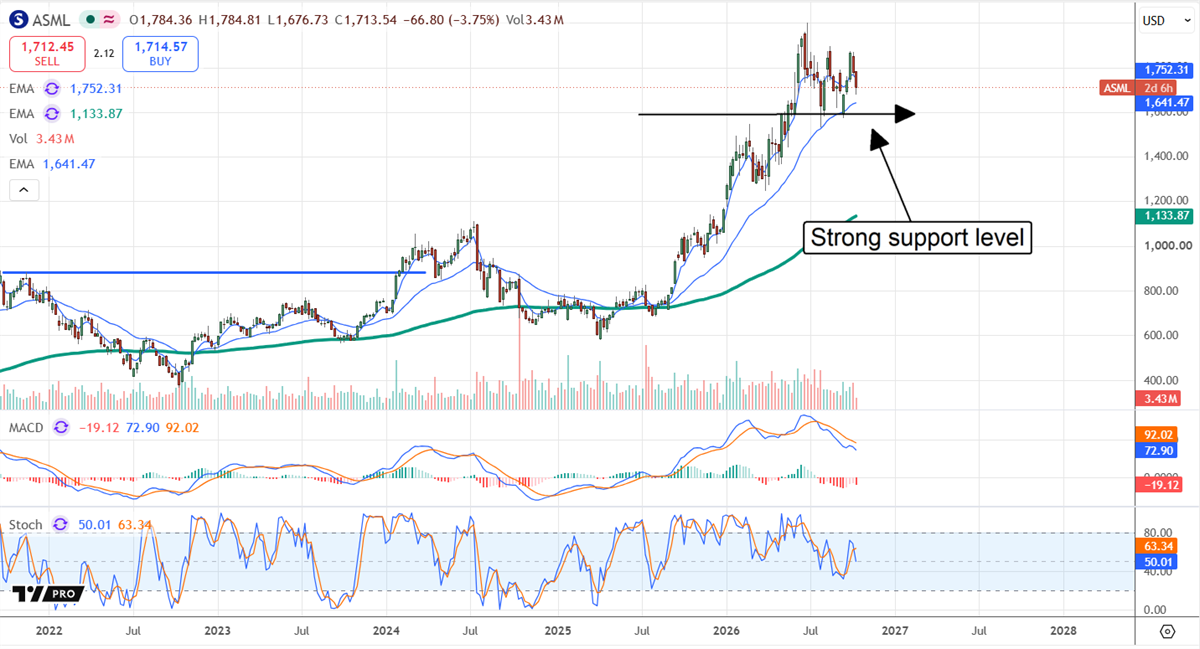
Critical resistance sits near the existing highs, a trigger point for capital inflow when it breaks. Assuming new highs are set, the patterns in place, including the consolidation and preceding rally, suggest a $500 to $600 move could follow, sufficient to match the analysts' high target range.
Don’t Mistake the Size and Depth of ASML’s Moat
Investors should not mistake ASML’s supply constraint for a weakness. The company has a deep moat as the only supplier of extreme ultraviolet lithography machines, the only machines that can make AI-capable chips. The company can’t lose demand; it can only put it off until it can meet it.
The question now becomes: is a capacity ramp really needed, since oversupplying the market can have far-reaching, long-lasting repercussions? Not ramping capacity means revenue and earnings visibility extends into the next decade.
ASML’s biggest risk is disruption. Another company could release a semiconductor printing machine superior to its product. However, the risk is slim, as there are no direct competitors today and emerging technology is still far from application. In this scenario, ASML is an execution story that needs only to meet demand at a steady pace, keep costs low, and drive cash flow and capital returns for its stock price to sustain upward movement.
Stocks Mentioned in this Article
| Company | Current Price | Price Change | Dividend Yield | P/E Ratio | Consensus Rating | Consensus Price Target |
|---|---|---|---|---|---|---|
| ASML (ASML) | $1,641.52 | -1.0% | 0.44% | 40.41 | Moderate Buy | $2,079.13 |