
AbbVie's Humira Era Is Fading, But Its New Growth Engines Face Another Test
- Skyrizi and Rinvoq continue to offset declining Humira revenue and drive AbbVie's immunology growth.
- AbbVie raised its full-year earnings guidance and announced a 5.2% dividend increase.
- Analyst optimism and institutional ownership support the investment case, although patent expirations remain a longer-term concern.
Believe it or not, Humira still drives headlines for AbbVie (NYSE: ABBV), despite contributing little to the company's growth. Once AbbVie's biggest revenue driver, sales fell to a paltry $683 million in Q3 due to its long-feared patent cliff, a catalyst that has come and gone. The patent cliff was once a market driver, but it's best forgotten. New blockbusters more than offset the difference, with Skyrizi alone bringing in more than $5.7 billion for the quarter, and a rapidly diversifying business could set the stage for long-term success.
AbbVie completed the Apogee Therapeutics acquisition during the quarter. Apogee Therapeutics is a clinical-stage biopharma focused on immunological and inflammatory diseases, complementing AbbVie’s core portfolio with several therapies in development. Other growth avenues include the Neurosciences and Oncology segments, which have promising pipelines of their own, in addition to today's drivers.
The Neurosciences segment is supported by Vraylar and Botox Therapeutic, along with Ubrelvy and Qulipta. Oncology is also contributing, although growth has been more modest. Looking ahead, the company has approximately one dozen promising therapies in advanced testing across segments, including expanded treatments for Skyrizi and Rinvoq. AbbVie expects those two drugs to generate more than $32 billion in combined sales in 2026.
AbbVie Beats and Raises: Raises Dividend, Stock Price Follows
AbbVie reported third-quarter results, with revenue of $17.4 billion, up 10.3% year over year and just above consensus. Sales were driven by a 16.3% increase in Immunology, including solid gains in Skyrizi and Rinvoq, a 19.4% increase in Neurosciences, and a 0.8% increase in Oncology. Aesthetics, including Botox Cosmetic, fell 1.4% but remains a cash driver.
Margin news is more impressive, with costs and acquired in-process research and development (IPR&D) milestones far less than last year, resulting in wider gross and operating margins. Adjusted operating margin came in at nearly 49%, up almost 18 percentage points, sufficient to drive triple-digit increases in the GAAP and adjusted earnings figures. Adjusted earnings per share of $3.82 grew 105%, outperforming MarketBeat’s consensus by about nine cents and enabling management to raise guidance for the second time this year.
The company significantly raised its adjusted earnings per share (EPS) target, setting the low end at $13.95, in line with consensus, and the high at $13.99. ABBV could perform near the high end of its forecast or potentially outperform it, given Q3 strengths and developments, including expanded approvals for key drugs.
AbbVie’s Dividend Growth Trajectory Is as Healthy as Ever
AbbVie’s investment appeal lies in its growth but centers on profitability, cash flow, and its capacity for capital returns. Share buybacks aren’t the primary driver but help keep the share count steady while dividends are distributed. The current dividend yields approximately 2.41% in early November, more than double the broad market average, with above-average distribution growth also forecasted. AbbVie has a Dividend King-level dividend growth record, including its history with Abbott Laboratories.
Analysts' response to Q3 results and guidance included several price target increases. Some analyst targets reach $340 or higher, and MarketBeat tracks 30 analyst ratings. The commentary focuses on execution and the higher guidance, which keeps them bullish. As it stands, the 30 analysts tracked rate the stock as a Moderate Buy with an 80% Buy-side bias and no Sell ratings logged, forecasting a slight correction at the consensus, but the trend matters. Consensus is up versus last year, last quarter, and early October, providing a tailwind.
Institutional investors have also been buying ABBV in 2026, with institutional ownership now exceeding 70% of shares. This reflects substantial institutional interest, although it doesn't guarantee support during market pullbacks. ABBV’s biggest risks are upcoming patent cliffs, including one for Skyrizi in 2033. Rinvoq also faces a cliff, but it's been pushed back until much later in the coming decade due to legal settlements. The offset is seven more years of Rinvoq growth and dominance, compounded by a robust pipeline that strengthens quarterly. Humira is no longer a risk.
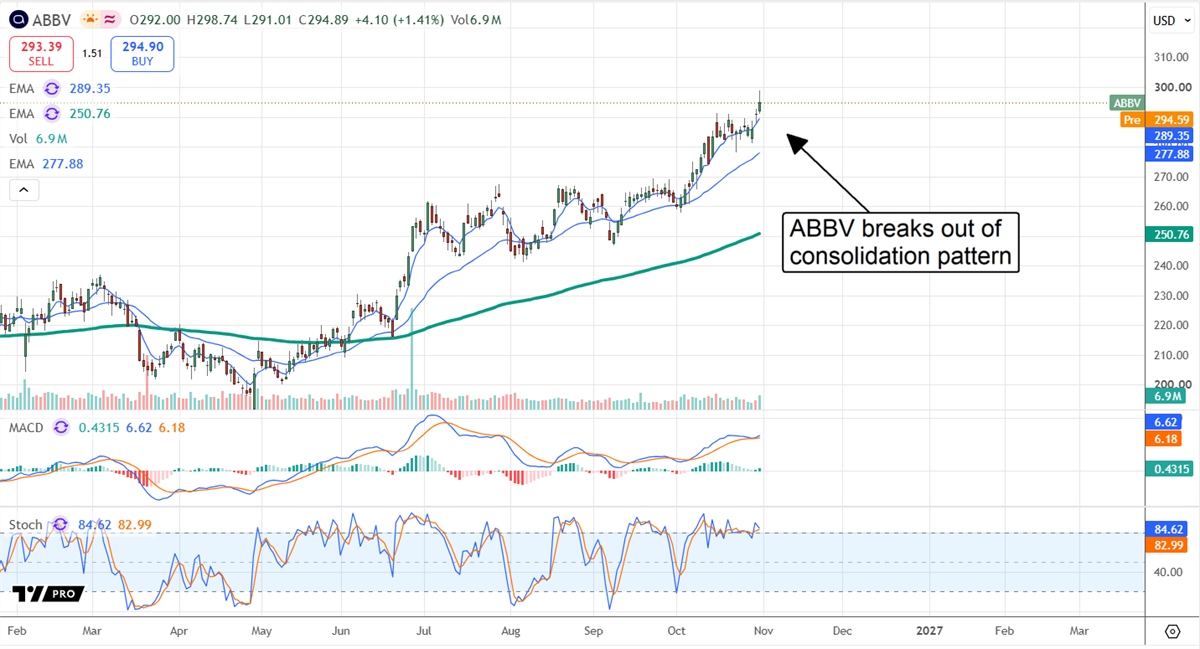
Chart price action is favorable following the release. ABBV shares moved up to a fresh high, breaking out of near-term consolidation. The pattern suggests potential upside of about $30, putting the near-term target near $320, just below the high end of analysts' forecasts. Longer-term price targets are even more favorable, reflecting expectations for continued growth.
Stocks Mentioned in this Article
| Company | Current Price | Price Change | Dividend Yield | P/E Ratio | Consensus Rating | Consensus Price Target |
|---|---|---|---|---|---|---|
| AbbVie (ABBV) | $288.47 | -0.1% | 2.40% | 49.69 | Moderate Buy | $294.67 |