
AbbVie Fires Healthy Trend-Following Signal: Is a Rebound Ahead?
- AbbVie is amid a trend-following opportunity, underpinned by cash flow and capital return.
- Institutions are accumulating aggressively, limiting downside risk in Q2.
- Analyst trends suggest a fresh all-time high is coming; the only question is how quickly the stock price will rise.
AbbVie's (NYSE: ABBV) share price has been under pressure due to rising costs and concerns that its post-Humira days won’t be as robust. However, the stock price decline put the market in a position to trigger a trend-following signal, which happened after its Q1 earnings results.
The results initially left the market wanting more, but the stock price drop at the open triggered a buying frenzy. Share price immediately moved up from the low, confirming support at a critical level and indicating high potential for a rebound.
AbbVie’s trend-following signal includes its long-term, 150-week exponential moving average (EMA), the price action, and indicators such as MACD and stochastic. The exponential moving average has served as a trend-line for many years, and the price action confirms it.
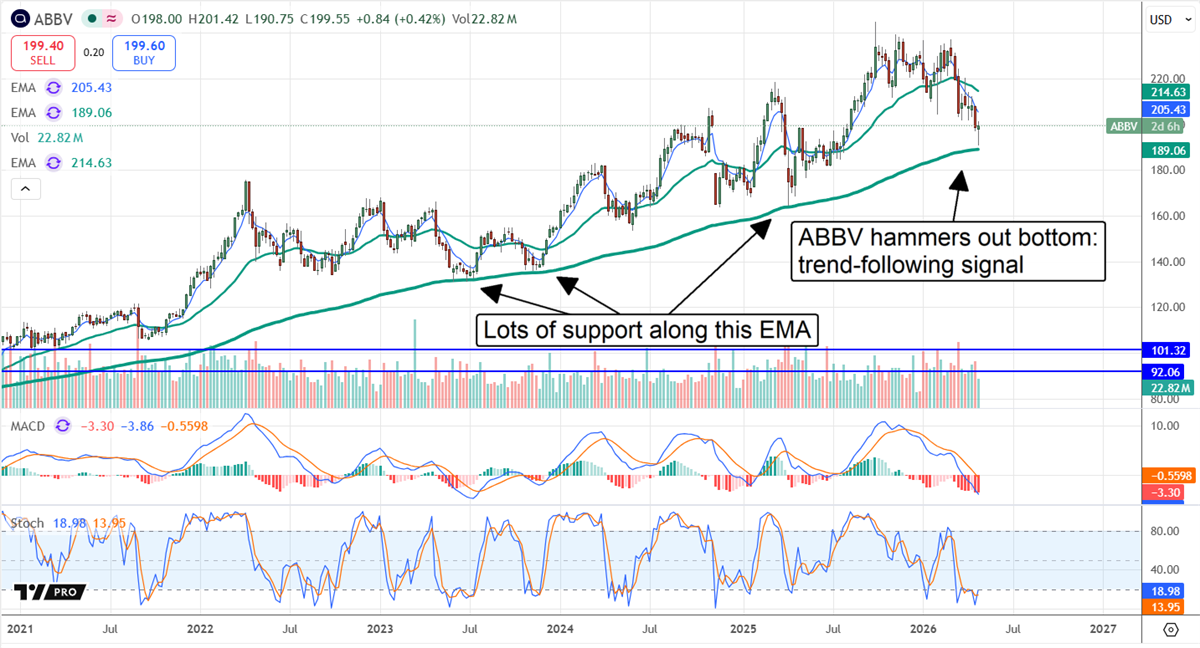
The candle formed is a Hammer Doji, a candle often signaling the end of a downtrend as the market hammers out its bottom. The indicators reveal that the market is oversold and that bearish momentum is extreme, setting the stage for a rebound. The question now is what may trigger the rebound, and it may be as simple as value and dividends.
AbbVie Presents a Value and Yield Opportunity Smart Money Is Buying
AbbVie stock trades at approximately 14X its current-year earnings forecast as of late April. That is about 40% below its long-running average, opening the door to a significant upside. The upside is underpinned by the dividend, which yields an attractive 3.4% at these levels with distribution growth in the forecast. AbbVie is as good as a Dividend King, given its relationship to Abbott Laboratories (NYSE: ABT), and has increased its payment every year since the spin-off.
The payout ratio is on the high side, around 65%, but this isn’t unusual for a dividend payer of this quality. The critical detail is the cash flow and balance sheet, which support the payment and its sustainability. As it stands, ABBV can sustain its payments and mid-single-digit compound annual growth rate (CAGR) for the foreseeable future, with no hiccups in sight.
Analyst forecasts align with the valuation. The 26 tracked by MarketBeat peg the stock at Moderate Buy with a 65% Buy-side bias and almost 30% upside at the consensus. The 2026 activity, leading into the Q1 report, included some price target reductions but nothing major, as the bulk of the moves aligned with a tight range around the consensus target. The likely outcome is that analysts' sentiment remains firm, although a market catalyst may not emerge from this vector until later in the year.
Institutional interest is far more robust. This group underpins the rebound outlook, owning more than 70% of the stock and aggressively accumulating over the trailing 12 months. MarketBeat data shows their activity ramping in Q1 2025, sustaining the high level through Q1 2026, and remaining bullish in early Q2, running at a greater than $2-to-$1 pace during that time. Activity in Q1 ramped up as price action fell, rising to over $4-to-$1, highlighting the value opportunity. Assuming this group continues to buy robustly, ABBV’s bottom is likely to be in, and the rebound is only a matter of time.
AbbVie Puts Patent Cliff in Rear-View Mirror
AbbVie’s Q1 results should put any concerns about its patent cliff behind it. Revenue grew by 12.4% to $15 billion on strength in Skyrizi and Rinvoq, with Humira sales lagging at $668 million, and new studies highlighting Rinvoq's efficacy. AbbVie said in a separate release that Rinvoq outperformed Humira on the primary endpoint and met secondary objectives, setting the stage for its continued outperformance in upcoming quarters. Segmentally, all but Oncology posted growth, led by a 26% increase in Neurosciences and 16.4% increase in Immunology.
Margin is another area of strength. The GAAP earnings came in well below forecasts due to acquired R&D milestones, but adjusted results were much better. The $2.65 in adjusted EPS increased by 7.7% compared to the prior year, only falling short of the consensus by a slim margin. Guidance, the more important factor, was more positive, with the company lifting its full-year adjusted EPS range to more closely align with market expectations. The likely outcome is that the company continues to execute well, including pipeline advancements, and outperforms in upcoming quarters.
This year’s catalysts include expected results from clinical trials, specifically in the Oncology portfolio, and the expansion of existing treatments. The company has numerous applications in progress for expanded coverage of key therapeutics, including blockbusters Rinvoq and Skyrizi. Risks include competition, specifically for Humira, but it diminishes with each passing quarter.